To be honest now I am alittle confused on what should do first and how I should do. I have no conception with critical design at all, so this time I need to start from zero. One problem is I know I should do a critical design and I will focus on the Media, but what my critical design looks like? How can I stimulate discussion and debate via my design? How can I lead people to discuss the Media problem? Is there any other aspects of suicide I can explore in a critical design method? So much things I need to do. I think the most important thing for me is to understand what is critical design and how critical design be designed and how it works. Therefore, literature review is the first thing I should do.
Thursday, 28 February 2008
Wednesday, 27 February 2008
Researches and My Idea on Nonverbal Communication
Once I thought about the concept nonverbal communication, the online chatting emotions came into my mind. I am a fan of chatting softwares, such as MSN, QQ and ICQ, and I am a experienced practitioner who is good at using emotions to express my feelings. I usually download emotions from the professional website and install them in my computer. There are thousands of emotion symbols and animitions extensively used by online chatting practitioners, and those symbols give people fun and happiness when they chatting online, so that people can enjoy their chatting experience.


Nonverbal communication for clinical department is different from for entertaining. I did some researches on the existing noverbal communication methods/systems in clinical field which help patient to communicate with doctors.
One of them is invention which discloses a communication device to facilitate the communication abilities of speech-impaired individuals. In particular, the communication device is designed to offer those speech-impaired individuals with limited manual motor capacities the ability to communicate quickly and unambiguously.

Another example is communication with nonverbal patients in India - augmentative communication devices. Various communication prostheses have been developed to augment the limited communication abilities in children and adults who are speechless because of developmental disabilities or neurological diseases. Communication boards remain the most economical of such communicative prostheses. Five communication boards in Hindi containing alphabet, words, and pictures are discussed, which were developed to assist non-verbal persons in northern India, and which have been used to promote communication with adults with stroke. These communication boards can equally be used with minimum modification by both developmentally disabled children and neurologically impaired adults.
Alphabet Communication Board
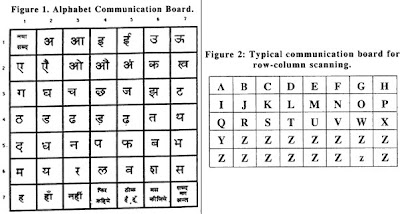
Lexical Communication Board

Eye-Gaze (E-Tran) Communication Board

Communication Board

Picture Communication Board

Blissymbol Communication Board

From the above examples, it is obviously that their nonverbal communication device is design for patient who is disable or inability to speak, and their device are very practical and more focussed. The nonverbal communication system I want to design is for suicidal people who reluctant to talk about their stories to professionals and clinicians face to face, but utilizing a communcating system or device which can use tons of symbols to express their experience and stories.
An idea came into my mind - can I design a gamelike system which gives suicidal people an oppotunity to play themselves according to their own story in a game? But they are only allowed to set their real personal information such as job, age, sex, background, hobbies and so on. I bet many people have played one of the most popular games - 'Sims', it's an amazing game that people can create their own characters and control the characters' life. It's a really good example for me to explore, but one important thing is my game is not for entertaining, but it tries to creat a relaxing enviornment for suicidal people to talk about their story in a tricky way. So there should be a strong and enormous database which support the clinical department to evaluate the risk of suicide of people who have finished playing the game.


Devices of the game 'Sims'
In addition, of course there will professional methods exist which teach possible suicidal people how to play the game efficiently and explain to them the purpose of the game - evaluate the risk factors of suicide. However, this idea is difficult for me to practice, because I am a graphic designer, not a game designer or a multi-media designer, so I have no idea about the database, the scripts and the related softwares. Therefore, my interest is tend to do the critical design in my project.

Nonverbal communication for clinical department is different from for entertaining. I did some researches on the existing noverbal communication methods/systems in clinical field which help patient to communicate with doctors.
One of them is invention which discloses a communication device to facilitate the communication abilities of speech-impaired individuals. In particular, the communication device is designed to offer those speech-impaired individuals with limited manual motor capacities the ability to communicate quickly and unambiguously.

Another example is communication with nonverbal patients in India - augmentative communication devices. Various communication prostheses have been developed to augment the limited communication abilities in children and adults who are speechless because of developmental disabilities or neurological diseases. Communication boards remain the most economical of such communicative prostheses. Five communication boards in Hindi containing alphabet, words, and pictures are discussed, which were developed to assist non-verbal persons in northern India, and which have been used to promote communication with adults with stroke. These communication boards can equally be used with minimum modification by both developmentally disabled children and neurologically impaired adults.
Alphabet Communication Board

Lexical Communication Board

Eye-Gaze (E-Tran) Communication Board

Communication Board

Picture Communication Board

Blissymbol Communication Board

From the above examples, it is obviously that their nonverbal communication device is design for patient who is disable or inability to speak, and their device are very practical and more focussed. The nonverbal communication system I want to design is for suicidal people who reluctant to talk about their stories to professionals and clinicians face to face, but utilizing a communcating system or device which can use tons of symbols to express their experience and stories.
An idea came into my mind - can I design a gamelike system which gives suicidal people an oppotunity to play themselves according to their own story in a game? But they are only allowed to set their real personal information such as job, age, sex, background, hobbies and so on. I bet many people have played one of the most popular games - 'Sims', it's an amazing game that people can create their own characters and control the characters' life. It's a really good example for me to explore, but one important thing is my game is not for entertaining, but it tries to creat a relaxing enviornment for suicidal people to talk about their story in a tricky way. So there should be a strong and enormous database which support the clinical department to evaluate the risk of suicide of people who have finished playing the game.


Devices of the game 'Sims'
In addition, of course there will professional methods exist which teach possible suicidal people how to play the game efficiently and explain to them the purpose of the game - evaluate the risk factors of suicide. However, this idea is difficult for me to practice, because I am a graphic designer, not a game designer or a multi-media designer, so I have no idea about the database, the scripts and the related softwares. Therefore, my interest is tend to do the critical design in my project.
Tuesday, 26 February 2008
An Email between Graham Pullin and I
From: Graham Pullin Tuesday - February 26, 2008 7:42 PM
To: Jia Cui
CC: Hazel White
Subject: Re: from MDes student Michelle
Hi Michelle
Thank you for your email and kind words.
Suicide is obviously an incredibly sensitive subject, so do proceed with care and respect and sensitivity - and look after yourself whilst doing this.
And complex and diverse I imagine: for some people there is the (cliche? I'm not sure) of a 'cry for help';
others may be depressed and resigned: the probably equally cliched 'preparing for sleep', beloved of crime writers.
Sorry, this is very 'Readers Digest Guide to Psychiatry' I know - but my *only* point is be extremely wary of stereotyping!
That is not to preclude an appropriate use of critical design or critical thinking for that matter:
the most profound issues deserve and demand this - which is why I would advocate design for/around/against disability to be another appropriate subject although this too would be controversial.
Noam Toran's work around loneliness seems closest, most poignant.
Alright, with that being said, here are some half-baked thoughts (I certainly wouldn't propose these ideas without knowing much more than I do):
Before deciding on a kit ('beautiful' is obviously a provocative quality) for people to kill themselves.
I wonder if you could tease apart the issues a little more, and identify something more specific.
... that extends to tying up all the loose ends and making sure you don't cause any upset to those who you know love you or might after all love you (obviously a nonsense, but in doing so could highlight this nonsense and the pain that can be left behind)
... that allows a cry for help without the act itself (I don't know: a countdown timer or voting system...)
... a placebo (a lot in the news today about placebo Prozac helping people with depression just by knowing that someone is noticing and trying to help by prescribing...)
... specifically for a winter suicide (that could highlight S.A.D.) or a Christmas suicide or New Year or Valentine's Day...
... a government** campaign to *promote* suicide? (perhaps it could help the NHS and reduce the unemployment figures?)
... reminds me of Frank Zappa's 'Suicide Chump', which once shamed me out of self pity
**: I'm sceptical of who would be talked out of suicide by an official government campaign, particularly young people, feeling alienated.
Reading these back, they sound like cheap gags, bad 'Pub Talk design', so please use them just to seed your own thoughts and then incinerate them...(that's the basis on which I share them)
Hope this helps a little
Best wishes
Graham
On 26 Feb 2008, at 13:12, Jia Cui wrote:
Hi Graham,
This is Michelle from MDes, the critical design workshop you ran at our studio last semester was really fantastic and very interesting.
I think maybe you would like to offer me some suggestions on my main project: how can design contribute to suicide prevention in Scotland? Actually it was my adviser Mike Press, he suggested me to do a critical design for my main project, also this is what I am really interested in and want to have a try.
Basically from my research of the suicide issue I found that a suicide prevention strategy/policy has been set by the government, and one of the policies is Media and information setting. The role of the media is increasing people's awareness on suicide and encourage suicidal people to seek professional help. But many researchers believe that high-profile news reports of deaths may push vulnerable or depressed people to commit copcat suicides. In one year in the 1970s, for example, there were 60 suicides by burning in the UK after reports of a woman burning herself to death in Switzerland. Such suicides are normally extremely rare.
So my idea is to design a beautiful kit for people to kill themselves in order to lead a discussion on the efficiency of national suicide prevention, especially the policy of media. Could you give me some ideas/suggestions on this issue from the perspective of critical design?
Thanks so much and look forward to hearing from you soon!
Kind regards,
Michelle
To: Jia Cui
CC: Hazel White
Subject: Re: from MDes student Michelle
Hi Michelle
Thank you for your email and kind words.
Suicide is obviously an incredibly sensitive subject, so do proceed with care and respect and sensitivity - and look after yourself whilst doing this.
And complex and diverse I imagine: for some people there is the (cliche? I'm not sure) of a 'cry for help';
others may be depressed and resigned: the probably equally cliched 'preparing for sleep', beloved of crime writers.
Sorry, this is very 'Readers Digest Guide to Psychiatry' I know - but my *only* point is be extremely wary of stereotyping!
That is not to preclude an appropriate use of critical design or critical thinking for that matter:
the most profound issues deserve and demand this - which is why I would advocate design for/around/against disability to be another appropriate subject although this too would be controversial.
Noam Toran's work around loneliness seems closest, most poignant.
Alright, with that being said, here are some half-baked thoughts (I certainly wouldn't propose these ideas without knowing much more than I do):
Before deciding on a kit ('beautiful' is obviously a provocative quality) for people to kill themselves.
I wonder if you could tease apart the issues a little more, and identify something more specific.
... that extends to tying up all the loose ends and making sure you don't cause any upset to those who you know love you or might after all love you (obviously a nonsense, but in doing so could highlight this nonsense and the pain that can be left behind)
... that allows a cry for help without the act itself (I don't know: a countdown timer or voting system...)
... a placebo (a lot in the news today about placebo Prozac helping people with depression just by knowing that someone is noticing and trying to help by prescribing...)
... specifically for a winter suicide (that could highlight S.A.D.) or a Christmas suicide or New Year or Valentine's Day...
... a government** campaign to *promote* suicide? (perhaps it could help the NHS and reduce the unemployment figures?)
... reminds me of Frank Zappa's 'Suicide Chump', which once shamed me out of self pity
**: I'm sceptical of who would be talked out of suicide by an official government campaign, particularly young people, feeling alienated.
Reading these back, they sound like cheap gags, bad 'Pub Talk design', so please use them just to seed your own thoughts and then incinerate them...(that's the basis on which I share them)
Hope this helps a little
Best wishes
Graham
On 26 Feb 2008, at 13:12, Jia Cui wrote:
Hi Graham,
This is Michelle from MDes, the critical design workshop you ran at our studio last semester was really fantastic and very interesting.
I think maybe you would like to offer me some suggestions on my main project: how can design contribute to suicide prevention in Scotland? Actually it was my adviser Mike Press, he suggested me to do a critical design for my main project, also this is what I am really interested in and want to have a try.
Basically from my research of the suicide issue I found that a suicide prevention strategy/policy has been set by the government, and one of the policies is Media and information setting. The role of the media is increasing people's awareness on suicide and encourage suicidal people to seek professional help. But many researchers believe that high-profile news reports of deaths may push vulnerable or depressed people to commit copcat suicides. In one year in the 1970s, for example, there were 60 suicides by burning in the UK after reports of a woman burning herself to death in Switzerland. Such suicides are normally extremely rare.
So my idea is to design a beautiful kit for people to kill themselves in order to lead a discussion on the efficiency of national suicide prevention, especially the policy of media. Could you give me some ideas/suggestions on this issue from the perspective of critical design?
Thanks so much and look forward to hearing from you soon!
Kind regards,
Michelle
Monday, 25 February 2008
Media Problems
Problems in community whole-system approaches.
One of the mental health promotion and supporting policy across settings is Media and information setting:
A. Mental health information strategy.
B. Public health obsevatory
C. National confidential inquiry
D. Mindout campaign
E. World mental health day
F. NUJ guidelines
G. Press complaints commission
H. Advertising standards authority
The key objectives for Media and information settings are:
A. Increasing positive media reporting.
B. Improving awareness of mental health.
C. Increasing local date
D. Improving access to information on services support and self-help.
However it is always be a question that what is the role of the media.
Many researchers believe that high-profile news reports of deaths may push vulnerable or depressed people to commit copycat suicides. In one year in the 1970s, for example, there were 60 suicides by burning in the UK after reports of a woman burning herself to death in Switzerland. Such suicides are normally extremely rare.
These deaths create a problems ofr journalists. Dramatic suicides are worth reporting. They usually interest readers a lot more than boring stories about parliamentary politics. So suicide prevention organizations are trying to teach journalists t owrite about them more sensitively.
The United Nations published reporting guidelines in 1996, advising the media not to focus on the hopelessness of the dead person's life or make suicide seem glamorous. They were told not to endlessly repeat the story or describe the method used. However, there is still a long way to go. In July 2001, the New York Post was criticized for a front-page story with the headline: 'Model found dead in pool of blood'. It went into great detail about how the woman had killed herself.
One of the mental health promotion and supporting policy across settings is Media and information setting:
A. Mental health information strategy.
B. Public health obsevatory
C. National confidential inquiry
D. Mindout campaign
E. World mental health day
F. NUJ guidelines
G. Press complaints commission
H. Advertising standards authority
The key objectives for Media and information settings are:
A. Increasing positive media reporting.
B. Improving awareness of mental health.
C. Increasing local date
D. Improving access to information on services support and self-help.
However it is always be a question that what is the role of the media.
Many researchers believe that high-profile news reports of deaths may push vulnerable or depressed people to commit copycat suicides. In one year in the 1970s, for example, there were 60 suicides by burning in the UK after reports of a woman burning herself to death in Switzerland. Such suicides are normally extremely rare.
These deaths create a problems ofr journalists. Dramatic suicides are worth reporting. They usually interest readers a lot more than boring stories about parliamentary politics. So suicide prevention organizations are trying to teach journalists t owrite about them more sensitively.
The United Nations published reporting guidelines in 1996, advising the media not to focus on the hopelessness of the dead person's life or make suicide seem glamorous. They were told not to endlessly repeat the story or describe the method used. However, there is still a long way to go. In July 2001, the New York Post was criticized for a front-page story with the headline: 'Model found dead in pool of blood'. It went into great detail about how the woman had killed herself.
Saturday, 23 February 2008
Can't Believe I Can Do That!
OMG what a busy week! No, what a period of busy time! What I've done? Critical review, my exhibition, the book 'New Approaches to Preventing Suicide' and the assignment 'Lost in Translation'. I can't believe I can do such many works only in two weeks, OMG can you imagine how busy and how crazy I was? Especially when I was writting critical review, what a painful experience! I watched the movie 'Control' more than three times, to be honest, I dreamed the plot and the characters of the movie for many times. OMG really wanted to kill myself!
I came to realize that I am suicidal, really. My depression began from the year 2006, when something terrible happened to me. From that time I have never felt happy... But anyway I am trying hard to be happy and forget the terrible thing...
Friday, 22 February 2008
Reflection on Tutorial 22 2 08

After this tutorial I felt relaxed and happy, I was stucked for a long time in my project, it seemed like I was trying hard to look for an access or a entrance in order to come into a new space, but I couldn't find it, it really made me frustrated. But today I got two clear accesses to go through, one is nonverbal communication, another one is critical design. As Mike and I talked about the problems I found, he suggested me to think about nonverbal communication, this is as same as what I thought about. But before I was not sure what sort of communication system I should do, now I was suggested to do a nonverbal communication around clinical department (counselling, A&E, GPs, mental illness service liaison, etc.) to help identify the high risk issues. And I will research on how nonverbal communication (symbols, objectives) works (based on visual communication/interactive device).
Critical design is another suggestion Mike gave me, and I am really interested in doing it. He reminded me the a chapter in the book 'Need to Know Teenage Suicide', the chapter talks about the role of Media in suicide and also I came to remember a news which report the young girls suicide in a small neighbourhood of a town in Wales. These facts show that Media sometimes is not to be considered as a method which can increase people's awareness on suicide, contrarily, it is a very dangerous medium and sources in suicide. So a critical design which towards the Media issue or other national and public motivations might be designed to start a discussion about the relationship between national suicide prevention strategy and suicide. So I will also do some research on critical design, because for me this is a new conception even I have taken a critical design workshop which launched by Graham last semester.
Labels:
critical design,
nonverbal communication,
reflection,
tutorial
Subscribe to:
Posts (Atom)